
Kroger's Digital Shelf Labels Are Expanding Fast. Here Is What Suppliers Should Understand.
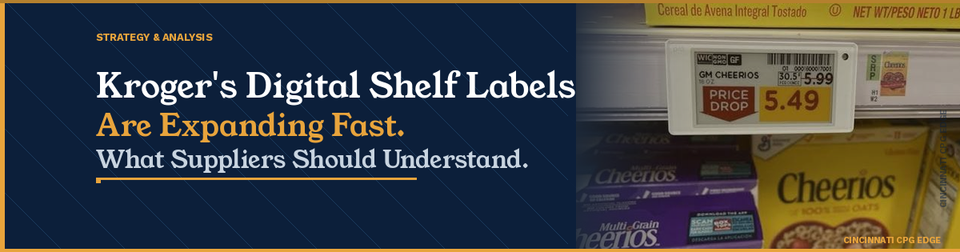
The next time you walk into a Kroger store, take a close look at the shelf tags. There is a good chance they are no longer paper. Kroger has been quietly rolling out electronic shelf labels across its store fleet, and the scale of that rollout has now crossed a threshold that every CPG supplier calling on Kroger should understand. Not because of what it means for shoppers. Because of what it means for your trade spend, your promoted price execution, and your negotiating position.
This technology is generating headlines right now mostly because of a political fight over surge pricing. That is a real story worth watching. But the supplier implications run deeper and have received almost no attention. Here is what we know, what is still unclear, and what questions CPG brands should be asking right now.
Electronic shelf labels, or ESLs, replace traditional paper price tags with small digital displays, similar in concept to the e-ink screen on a Kindle. The technology has been common in European grocery retail for years. What is new is the scale at which Kroger and Walmart are now deploying it across U.S. stores simultaneously.
The operational appeal is straightforward. Changing paper price tags across a large grocery store is labor intensive, error prone, and a source of persistent compliance gaps between what is in the system and what is on the shelf. ESLs eliminate that friction almost entirely. A price update that previously required a store employee to physically walk the aisle can now happen in seconds from a central system, across every store in a division simultaneously if needed.
For a CEO who has made operational efficiency the cornerstone of his 2026 agenda, ESLs fit neatly into the broader Foran playbook. The labor savings are real, the execution improvement is real, and the technology fits alongside Kroger's ongoing investments in AI, supply chain modernization, and centralized operations.
The headline controversy around ESLs is not about operational efficiency. It is about what the same infrastructure could theoretically enable. The same system that lets Kroger drop a promoted price instantly also lets them raise a price instantly, based on time of day, store traffic, inventory levels, or algorithmic demand signals. That is surge pricing, and in the context of grocery staples, it has generated sharp political backlash.
Several U.S. Senators and the New York Attorney General have raised formal concerns, arguing that the technology opens the door to predatory pricing on food essentials. Kroger has not publicly announced any plans to use dynamic pricing in its stores, and its official position has focused entirely on the labor efficiency benefits. But the political pressure is real, and several states are actively considering legislation that would restrict dynamic pricing on grocery items specifically.
The surge pricing debate is the story most outlets are covering. The supplier implications are the story they are not. For CPG brands calling on Kroger, ESLs create a set of dynamics that are worth understanding now, before they show up in a category review conversation or a trade spend reconciliation.
Promoted price execution becomes far more auditable.
Today there is meaningful slippage between what a supplier funds as a promoted price and what actually executes at shelf. Tag errors, timing gaps, and store-level inconsistencies have historically given brands some cushion in trade spend reconciliation. ESLs eliminate most of that slippage. When Kroger can verify exactly when a price changed, how long it held, and whether it matched the funded rate, promoted compliance becomes a much more precise and auditable conversation. Brands that have relied on execution looseness to manage their trade economics should take note.
Promoted price changes can now execute simultaneously across all stores.
One of the persistent frustrations in Kroger promotional execution has been the lag between when a deal goes live in the system and when it actually appears on every shelf in every store. ESLs solve that problem entirely. A funded promoted price can now roll across every authorized store in a division at the same moment. That is genuinely good for supplier compliance measurement. It also means Kroger has complete, real-time visibility into your promotional execution in a way they have never had before.
Price negotiation timelines could accelerate.
One of the practical barriers to rapid price changes in grocery has always been the operational lead time required to physically update shelf tags across hundreds of stores. That barrier is disappearing. If Kroger can execute a price change overnight rather than over weeks, the urgency timeline on supplier cost and pricing conversations changes meaningfully. Expect the pace of those negotiations to increase as the ESL footprint grows.
Competitive price response becomes near real-time.
ESLs mean Kroger can monitor and respond to competitive pricing moves faster than ever before. If a nearby competitor drops price on a product that competes directly with yours, Kroger can respond the same day on shelf. That competitive responsiveness adds pressure on any national brand competing on price against both private label and other national brands, because the speed of the competitive pricing environment just increased significantly.
Dynamic pricing and trade spend interaction is an open question.
This is the one that does not have a clear answer yet and that suppliers should be asking about directly. If Kroger's pricing system can adjust shelf prices dynamically based on demand signals, what happens to a supplier-funded promoted price during a high-traffic period. Does the funded rate hold or does the algorithm have the ability to override it. What does that mean for your trade spend ROI calculation. These questions are not hypothetical, they are contractual and financial, and the answers will matter for how trade deals are structured going forward.
The scale of this rollout is what makes it a structural shift rather than a technology experiment. When the two largest grocery retailers in the United States are deploying the same shelf pricing infrastructure simultaneously, the industry standard is being reset. Suppliers who understand the implications now, before ESLs are in every store and before the trade spend and compliance conversations catch up, will be better positioned than those who wait to see how it plays out.
There is still genuine uncertainty here. Kroger has not announced dynamic pricing plans. The legislative environment is unsettled. The full implications for trade spend structure and promoted compliance reporting are still developing. Cincinnati CPG Edge will follow this story as it moves, including whether the June 18 earnings call surfaces any analyst questions about ESL strategy and pricing intentions.
Found this useful? Share it.
Stay in the Kroger know.
From Cincinnati CPG Edge, keeping you in the Kroger know.




Member discussion